History and Culture
At Tea Chest Hawaii, founders Byron and Satomi Goo have built the company around an understanding of tea and a strong connection to Hawaii that continues to grow even after 30 years in business. They work with local growers and explore what can be grown in the islands. They create Hawaii-inspired teas shaped by taste, culture, and where they grew up.
Born in Japan, Satomi’s uncle is a Urasenke tea master, and she was required to take tea ceremony as a rite of passage. Byron’s affinity for tea began while living in Taiwan. When he returned to Hawaii, the local food scene was changing. The Hawaii Regional Cuisine movement was getting started. People were becoming more curious about food and new flavors. Yet tea remained largely overlooked. “Tea was sold by two colors, green and black, by the same person who sold dishwashing soap,” Byron recalls. “There was an opportunity to share the love for tea with others.”

For Byron and Satomi, flavors rooted in Hawaiian culture are often tied to personal memories and experiences. “One could say my own personal history lives in our products,” Byron says. “In tea making, I’m driven by my memories of how things taste.”
One of those memories comes from Manoa Valley, where Byron grew up. As a child, he biked and played throughout the valley, where lilikoi grew along the Manoa Stream. Picking ripe fruit from the vine became part of his childhood and left him with a particular memory of its flavor.
“There’s a specific tanginess to vine-ripened lilikoi that I wanted to capture,” Byron says.
That memory inspired Passionfruit Iced Tea. Today, it remains one of the company’s best-selling flavored teas. What began as a childhood memory became a tea to share with people worldwide.
The same curiosity has led the couple to explore other fruits and flavors found throughout the islands. Strawberry guava became part of Strawberry Hula. ʻOhelo berry inspired Lava Berry. The company was the first and only to make Poha Berry tea.
Working with growers in tea-growing countries like Japan, Taiwan, and India gave the couple a foundation for working with local growers and the hope that one day tea could grow and be made in Hawaii. Byron has worked closely with researchers at USDA and the University of Hawai’i. “Dr. Francis Zee, the godfather of Hawaii-grown tea, and I would stay up late nights processing tea to test which varietals produced the best tea. I spent countless hours with Milton Yamasaki, the Manager of the University of Hawaii’s Mealani Research Station on the Big Island. These two men were instrumental in getting the industry off the ground,” recalls Byron.
Tea Chest Hawaii has since worked with more than 30 farms across the state, growing both Camellia sinensis and other ingredients used to make tea.
Growing the plant is only the beginning. Value-added processing after harvest is critical to taste. Leaves are withered, rolled, oxidized, and dried. Each step changes the tea and helps develop its aroma, flavor, and character. “70% of a tea’s taste and value comes from processing,” he says.

A‘a Black from Hawaii Island is a world-class Hawaii-grown tea. The farm’s terroir is unmatched. The tea grows on a 400-year-old bed of volcanic ash surrounded by native ʻohiʻa forest. Cool, misty mornings give way to afternoons of tropical sunshine. Tea maker Eliah Halpenny handles the leaves by hand, from plucking through processing. The result carries a sense of the place where it was grown. “The bouquet is filled with ʻohiʻa blossoms with notes of dried banana and honey,” Byron says. “The tea is unforgettable.”
Hawaii’s volcanic landscapes and tropical growing conditions give local tea makers something distinctive to work with. But Hawaii’s tea story does not end with Camellia sinensis. Other plants grown in the islands have become part of the story.
One of them is mamaki. Endemic to the Hawaiian Islands, mamaki grows naturally nowhere else in the world. The plant has 400 years of use in Hawaiian culture and offers meaningful health benefits that are now being studied by the FDA and in cancer research. Mamaki can be brewed into an herbal tea. Tea Chest Hawaii works with mamaki grown in the islands and uses it in several ways. Pure Mamaki allows the plant’s character to stand on its own. Mint Mamaki and Jasmine Mamaki pair it with other flavors. Each offers a different expression of an ingredient that is uniquely Hawaiian.

Cacao has opened another path for exploring what can be grown and made in Hawaii. Hawaii is the only U.S. state with commercial cacao production, with cacao now grown on Hawaiʻi Island, Oʻahu, Maui and Kauaʻi. Hawaii-grown cacao has also earned international recognition, helping build awareness of another agricultural crop with potential in the islands.
Tea Chest Hawaii found its own place in that story. During chocolate making, cacao beans are roasted, and the nibs are separated from their shells. Those shells are a by-product of chocolate making. Byron saw something more.
“This was a fun project because it fit into our philosophy of sustainability. The shells were being thrown away, yet they still had incredible flavor and aroma. goal was to create new value for something that was being thrown away. The Japanese say mottainai, which translates to “What a waste!” to throw away something that still has value. The challenge was to unlock the value.
That idea became a collection of teas made with roasted cacao shells. Lilikoi Cacao brings together the richness of cacao and the bright sweetness of passionfruit. The result is like drinking a passionfruit truffle. Cacao Colada pairs cacao with pineapple and coconut. The combination is playful and familiar, bringing flavors associated with Hawaii into a different experience.
The company has a deep understanding of how tea is made and the cultures that shape how teas taste. This allows them to infuse Hawaii into their products tastefully and purposefully. This ability has helped Tea Chest Hawaii continue to evolve for more than three decades. The company began with Byron and Satomi wanting to share their love of tea. Over time, that passion grew into a purpose: How to create refined taste that is rooted in Hawaii.
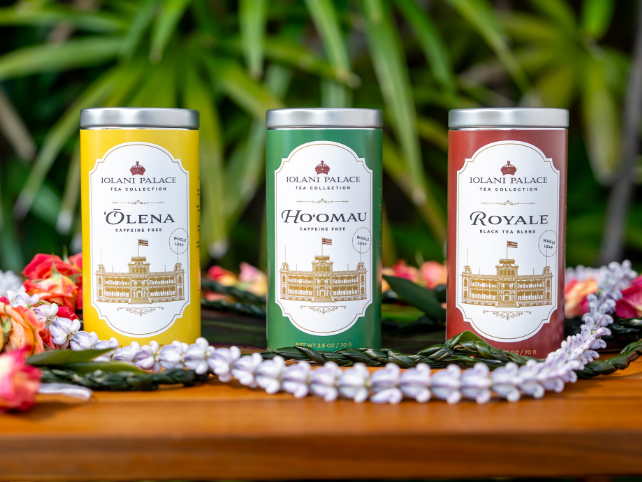
In 2024, we worked with First Lady Jamie Kanani Green to host Afternoon Tea for visiting dignitaries in Hawai’i for the Festival of Pacific Arts and Culture. Over 25 nations attend the festival. The First Lady wanted to follow in the footsteps of Queen Liliuokalani, who often met with visitors and confidants over tea service, including when she was confined to house arrest after the overthrow of the Kingdom of Hawai’i and the monarchy. Finding out about Liliuokalani’s passion for tea led to the creation of the ‘Iolani Palace Collection. The collection honors the hard decisions and sacrifices Liliuokalani made to spare her people's lives, remember the overthrow of the Kingdom of Hawai’i, and help preserve a celebrated place in Hawaiian history.
Hawaiian History Month gave us a chance to talk to our founders about some of the unique things they’ve learned along the journey. The history of tea in Hawai’i continues to be written, and Tea Chest Hawaii continues to play an active role in tea from Hawaii.
Video Ref: The Inspiration Behind Tea Chest Hawaii | Hawaiian History Month Bank of Hawaii, 2026
Q&A: Tea and Cacao Grown in Hawaii
Is tea grown in Hawaii?
Yes. Camellia sinensis is grown in Hawaii and can be processed into black tea and other styles of true tea. Tea Chest Hawaii has worked with about 30 farms across the state, exploring both tea cultivation and Hawaii-grown ingredients that can be used in tea. The company received a USDA specialty crop grant. The grant doubled the number of plants and increased tea-cultivation acreage in Hawaii.
What is Hawaii-grown tea?
Hawaii-grown tea refers to tea made with plants that are grown in Hawaii. This includes Camellia sinensis, mamaki, and other plants that are cultivated in the Hawaiian Islands.
What makes Hawaii-grown tea different?
Hawaii is home to 23 distinct climate zones that offer diverse landscapes, including volcanic and tropical growing conditions, along with ranges of elevations, rainfall, and sunlight. These conditions give growers different environments for cultivating tea. Processing also plays an important role, with methods such as withering, rolling, oxidation, and drying helping develop the tea’s final aroma and flavor.
What is mamaki tea?
Mamaki is an endemic Hawaiian plant whose leaves can be brewed as an herbal tea. Unlike black, green or other true teas, mamaki does not come from Camellia sinensis. Tea Chest Hawaii works with Hawaii-grown mamaki and offers Pure Mamaki as well as blends such as Mint Mamaki and Jasmine Mamaki.
Is mamaki only found in Hawaii?
Yes, mamaki is an endemic plant to the Hawaiian Islands, meaning it occurs naturally only in Hawaii. Its connection to the islands and its long history of local use make it a distinctive part of Hawaii’s tea story.
Is cacao grown in Hawaii?
Yes. Cacao is commercially grown in Hawaii, including on Hawaiʻi Island, Oʻahu, Maui, and Kauaʻi. Hawaii is the only U.S. state with commercial cacao production and is the northernmost point on Earth where cacao has been cultivated.
Is Hawaii known for high-quality cacao?
Hawaii has a burgeoning community of cacao growers and chocolate makers. Hawaii-grown cacao has received international recognition. Cacao from a University of Hawaii field trial won at the 2017 International Cocoa Awards in Paris, while Manoa Chocolate has earned critical acclaim for its chocolate.
What is cacao tea?
Cacao tea is a brewed drink that uses parts of the cacao plant to provide chocolate aroma and flavor. Tea Chest Hawaii uses roasted cacao shells in several of its teas. The shells are separated from cacao nibs during chocolate making and can be steeped or blended with other tea ingredients.
What does cacao tea taste like?
Roasted cacao shells add chocolate aroma and flavor to a brewed drink without making it taste like hot chocolate. Tea Chest Hawaii combines cacao with other flavors to create different profiles. Lilikoi Cacao pairs cacao with tangy passionfruit, while Cacao Colada combines cacao with pineapple and coconut.
Is cacao tea the same as hot chocolate?
No. Hot chocolate is generally made with cocoa or chocolate and often includes ingredients such as milk and sugar. Cacao tea is brewed in water using cacao ingredients. Tea Chest Hawaii’s cacao teas use roasted cacao shells to bring chocolate character to the cup.
Does Hawaii produce black tea?
Yes. Camellia sinensis grown in Hawaii can be processed into black tea. A‘a Black is one example. It is grown on Hawaii Island and handcrafted in small batches.
What does Hawaii-grown tea taste like?
No single flavor defines Hawaii-grown tea. Flavor can vary depending on where the plant is grown and how the leaves are processed. Byron describes A‘a Black as having a bouquet of ʻohiʻa blossoms with notes of dried banana and honey.
What teas are inspired by flavors from Hawaii?
Tea Chest Hawaii has developed several teas around flavors familiar in the islands. Passionfruit Iced Tea was inspired by Byron Goo’s childhood memories of vine-ripened lilikoi in Manoa. Strawberry Hula draws on strawberry guava, while Lava Berry was inspired by ʻOhelo berry. Tea Chest has also explored poha and created cacao teas that bring together flavors such as cacao, lilikoi, pineapple, and coconut.
What Hawaii-grown ingredients can be found in tea?
Hawaii’s tea story extends beyond Camellia sinensis. Tea Chest Hawaii has worked with Hawaii-grown tea, mamaki, and locally grown cacao, along with flavors inspired by fruits found throughout the islands. Together, these ingredients offer different ways to experience what Hawaii can bring to the cup.
Share:
Hawaii's Gift for Wellness, Culture & Community
How Mamaki Makes the World a Better Place